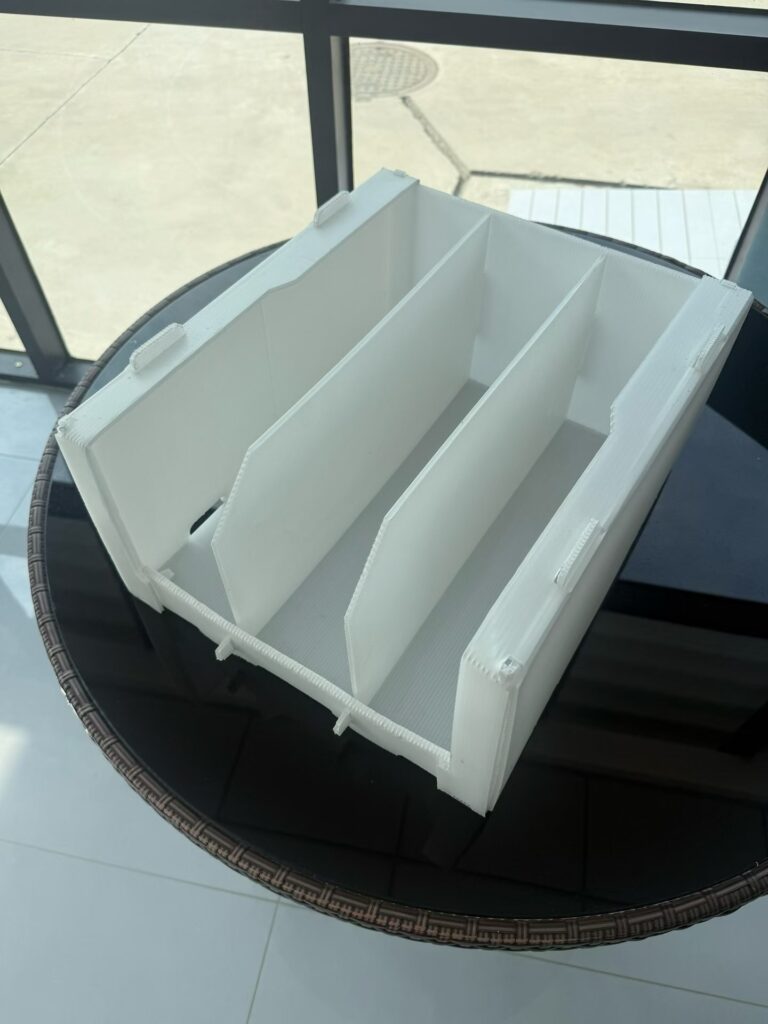
A divider can match the dimensions on a drawing and still be difficult to use. The drawing may describe the part, an individual strip or the overall grid, while the problem occurs at the assembled opening or during loading. Identify where the difficulty happens before changing the design.
Use the checks below to document a sample problem. They help separate measurement, assembly and access questions; they do not establish a load rating or approve the packaging for transport.
The part is tight in an assembled cell
Compare the largest envelope of the packed part with the clear opening of the assembled cell. Include protrusions and any wrapping that will remain on the part. Check the measurement direction and units, then identify the drawing revision and sample being compared.
A strip dimension or an overall grid dimension does not establish the space available inside one cell. Use the divider cell measurement guide to label those measurements separately.
Record the location of the tight cell, the measured opening and the point where the part makes contact. If parts vary, identify which part was checked. Leave the required clearance open for review rather than applying one allowance to every part and handling task.
The part fits at rest but catches during loading or removal
Check the movement used to place and remove the part. A component may need to tilt or rotate before it reaches its resting position. A protrusion, a restricted contact surface or the operator's approach can make that path different from the final packed outline.
Mark the loading direction and the point where the movement stops. A short video can show the sequence; an annotated photograph can identify the contact location. State whether the divider was fully assembled and installed in its intended container.
Record any adjustment needed to complete the task, such as lifting a strip or moving a neighboring part. Treat the adjustment as an observation to resolve. The divider design inputs guide explains how to document orientation, access and contact restrictions for the next revision.
The grid does not fit the intended container
Measure the usable space in the actual container at the position where the grid sits. Identify ribs, tapered walls, corners, fittings or lid features that limit that space. State whether the container measurements are internal or external.
Compare the overall assembled grid with that usable space, then check the cells separately. Reducing a cell opening to solve an outside-fit problem can create a different problem for the part. Keep both sets of measurements in the review.
Record the container reference, grid orientation and any forced bending or trimming used during the trial. A grid that fits only after an undocumented alteration needs that alteration reviewed before the configuration is accepted.
The part moves more than intended
Describe the movement and where it occurs. Identify the direction, contact surfaces, loading arrangement and assembly condition. State whether the observation came from a stationary fit check or a defined handling task.
Do not treat “make every cell smaller” as the agreed correction. Review the observed movement alongside loading access, part variation and any sensitive surfaces. Record the proposed change and repeat the affected check on the revised sample.
Close the issue with a traceable sample check
Keep one record containing the sample and drawing revision, part and container references, measurement points, observed problem, proposed change and next check. Separate what happened from what you think caused it. The sample feedback guide provides a structure for reporting the evidence and next action.
Approve only the configuration and checks that were completed. Fit and access observations do not establish stacking, transport performance or service life. If a later order uses a changed part, container or drawing, use the divider reorder revision check before carrying the earlier approval forward.