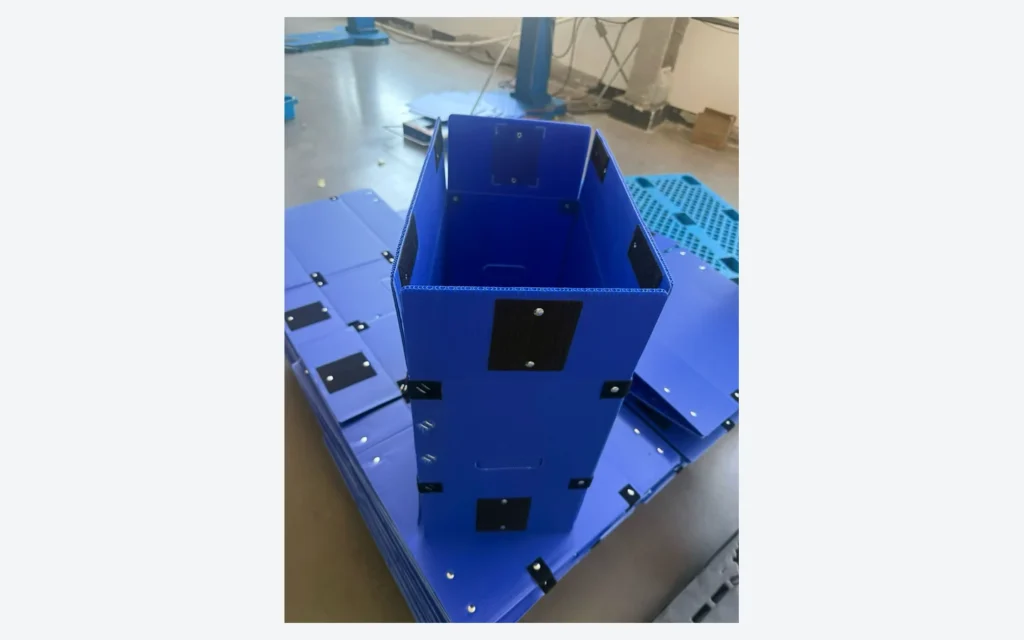
To specify a PP corrugated picking bin for a shelf, check three things together: the shelf opening, the space occupied by the finished bin, and the path used to load and remove each part. A bin that fits inside a shelf bay may still leave too little room for a hand, a tilted component or replenishment from above.
This guide is a practical starting point for automotive parts distributors and industrial teams reviewing manual picking. It does not assign a load rating or approve a container for transport.
Start with the picking task
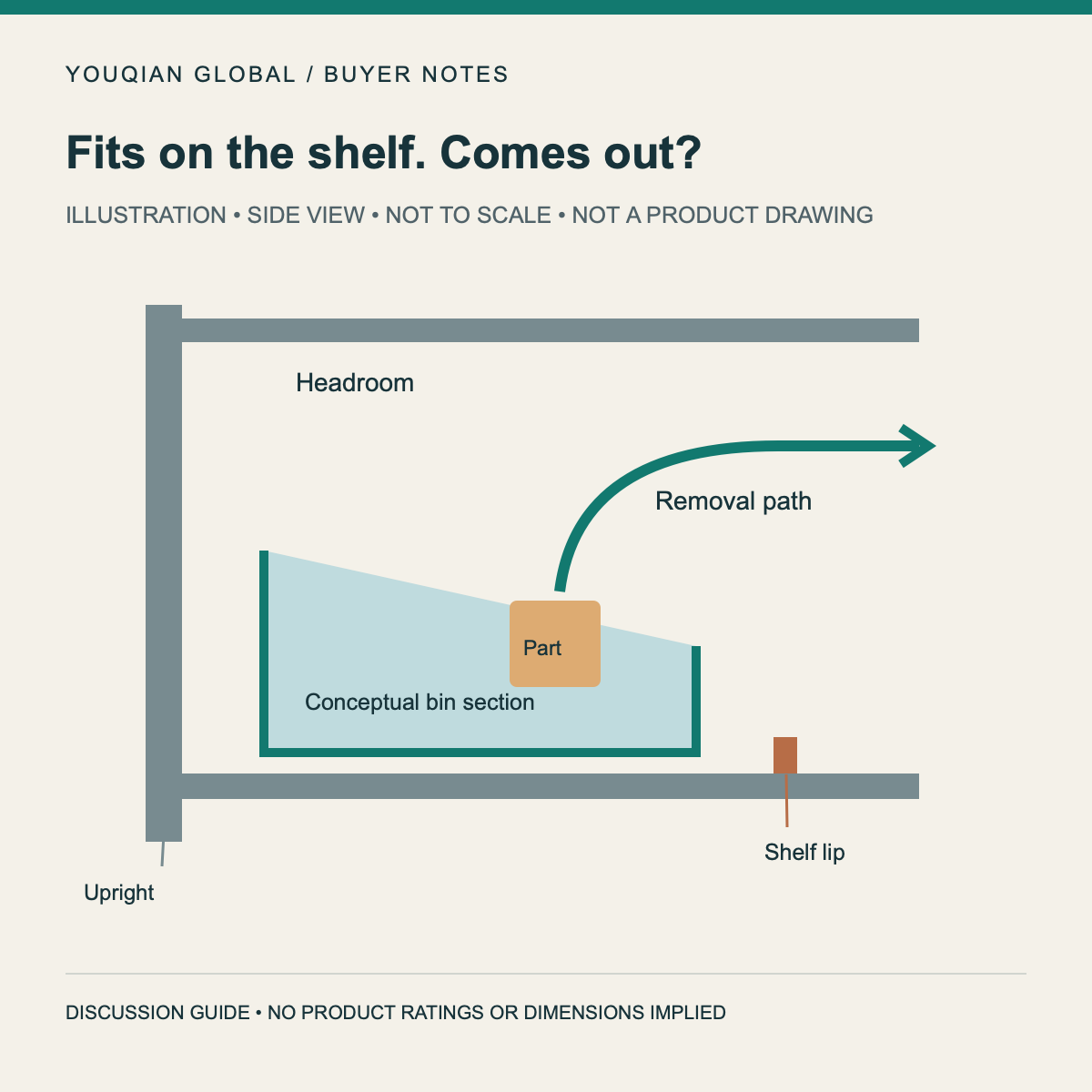
Describe what the operator actually does. Does the bin remain on the shelf during picking, slide forward, or come off the shelf entirely? Is replenishment done from the same side? Must one person hold the bin while removing a part?
For example, a part may sit comfortably inside a compartment but need to rotate before it clears the opening. Record that movement in the review. A top-view drawing alone can miss it.
Include the location of labels and the arrangement of neighbouring bins. If the identifier becomes hidden when stock is loaded, the label position needs another look before the layout is approved.
Record the shelf and bin separately
Use a sketch or annotated photograph to identify the measurement points. State the units and label each value rather than sending an unqualified length × width × height.
| Check | What to record | What the sample should demonstrate |
|---|---|---|
| Shelf opening | Clear width, usable depth and vertical space at the intended position | The finished bin enters and sits in its intended position |
| Obstructions | Shelf lips, uprights, braces and anything projecting into the opening | The loading and removal path clears these features |
| Finished bin | Overall dimensions including projecting fittings | The reviewed assembly fits, not just the sheet blank |
| Part arrangement | Largest part envelope, orientation and quantity in each location | Parts can be placed and removed in the intended order |
| Picking access | Hand approach, any gloves used, front opening and clearance above | The intended operator can complete the required movement |
| Replenishment | Loading direction and whether the bin stays on the shelf | Stock can be replenished in the agreed working position |
For the distinction between external dimensions and usable space, see our PP corrugated box internal and external size guide.
Review open-front access in context
A lower front can be considered where parts are picked from the front of a shelf. It should be reviewed with the part shape and the intended handling method. The access opening also changes the boundary that keeps contents in place.
Ask whether the contents stay in their intended position during the movements the bin will actually experience. If a loaded bin will be carried elsewhere, include that operation in the review. Do not assume that a shelf-access check also validates loaded carrying or transport.
Where different parts share a bin, check the busiest and most awkward locations. A compartment holding a small part and one holding an irregular component may need different access arrangements. Photograph the intended loading pattern so the drawing and sample review refer to the same configuration.
Run a sample check at the intended shelf
Agree on the checks before preparing a sample. A useful sequence is:
- Identify the sample revision, shelf position and representative parts.
- Place the empty bin in position and check its seating and removal path.
- Load the agreed quantity in the intended arrangement.
- Pick from the front, rear and any difficult compartments using the normal working method.
- Replenish the bin and check whether nearby stock or shelving obstructs the movement.
- Record any snag, hidden label, unwanted part movement or extra handling step.
- List the changes, person responsible and next review date before accepting a revision.
Use written observations and photographs to compare revisions. If a check was not performed, leave it open instead of marking the sample as fully approved.
Do not approve the layout while a required picking or replenishment path remains obstructed. Record the proposed change and repeat the affected check on the revised sample; an unrelated successful check does not close that issue.
Fit and access are only part of validation. Any required load, stacking, cleaning, repeated handling or transport performance needs its own agreed conditions and acceptance criteria.
Decide what to change after a failed check
If the finished bin cannot pass a shelf lip or projecting fitting, review the outside envelope and insertion path before changing the internal layout. If the bin seats correctly but a part catches a divider, review the clear compartment opening and the part’s loading direction instead. These failures call for different changes.
Moving a divider can improve access, but may reduce the quantity per bin or change the separation between parts. Record that trade-off before choosing the revised arrangement. If removal depends on an empty neighbouring compartment, include that condition in the loading instructions.
Where nominal clearance is tight, request a tolerance review covering the assembled box, dividers and relevant part variation. A sample that works only after hand adjustment does not establish repeatable production fit. Record the adjustment and resolve its cause before closing the issue.
Keep the revised drawing and sample observations together. Approve the checked configuration only when the agreed criteria are met; leave untested loading patterns and handling conditions open.
Discuss a configuration with Youqian Global
Youqian Global’s range includes custom PP corrugated boxes and interlocking PP dividers. For a shelf application, submit the bin and insert requirements together, including the available space and the part-removal problem. Final construction and supply terms require project confirmation.
What to send for an initial review
Send the following information with your inquiry:
- Shelf opening measurements and photographs showing obstructions.
- Part dimensions, individual weight and intended quantity per bin.
- Loading arrangement and any separation or sensitive-contact requirements.
- Whether picking and replenishment happen with the bin on the shelf.
- Expected movement, storage and handling conditions.
- Required order quantity, destination country and requested timing.
- Items that are still unknown and need review.
Explore Youqian Global’s PP corrugated box options or send your shelf and part information for a project review. Structure, supply conditions and validation requirements should be confirmed for the specific project before ordering.
Common questions
Is the outside bin size enough to check shelf fit?
It is one input. Include shelf obstructions, projecting fittings and the movement needed for picking, replenishment and bin removal.
Does a successful fit check confirm stacking capacity?
No. A fit check establishes what was observed for that configuration. Stacking needs separately agreed load, arrangement and validation conditions.
Can one bin layout be used for several part sizes?
It can be evaluated, but include the relevant part combinations and loading patterns in the review. Do not approve all configurations from a check using only one convenient part.