A reusable PP corrugated box costs money each time it goes through the return loop. Its cost per trip depends on the purchase price, how many loaded trips it completes, and what it costs to collect, check and prepare it for reuse. A cheaper box may cost more to operate. Even a durable box can fall short of the planned trip count if it stays at a customer’s warehouse or never returns.
Compare both packaging options on the same transport job over the same period. Divide the total packaging-program cost by the loaded box trips completed during that period. Until operating records support the inputs, the result is a planning estimate.
What counts as one trip?
One loaded box trip means one box carrying its agreed load from the defined dispatch point to the receiving point. Count the empty return as an operating cost. It does not add a loaded trip. If several loaded boxes travel on one pallet, count a trip for each box.
Record how many product units each box carries. When two designs carry different quantities, compare the cost per delivered product unit as well as the cost per box trip. Another agreed measure of equivalent output can also work.
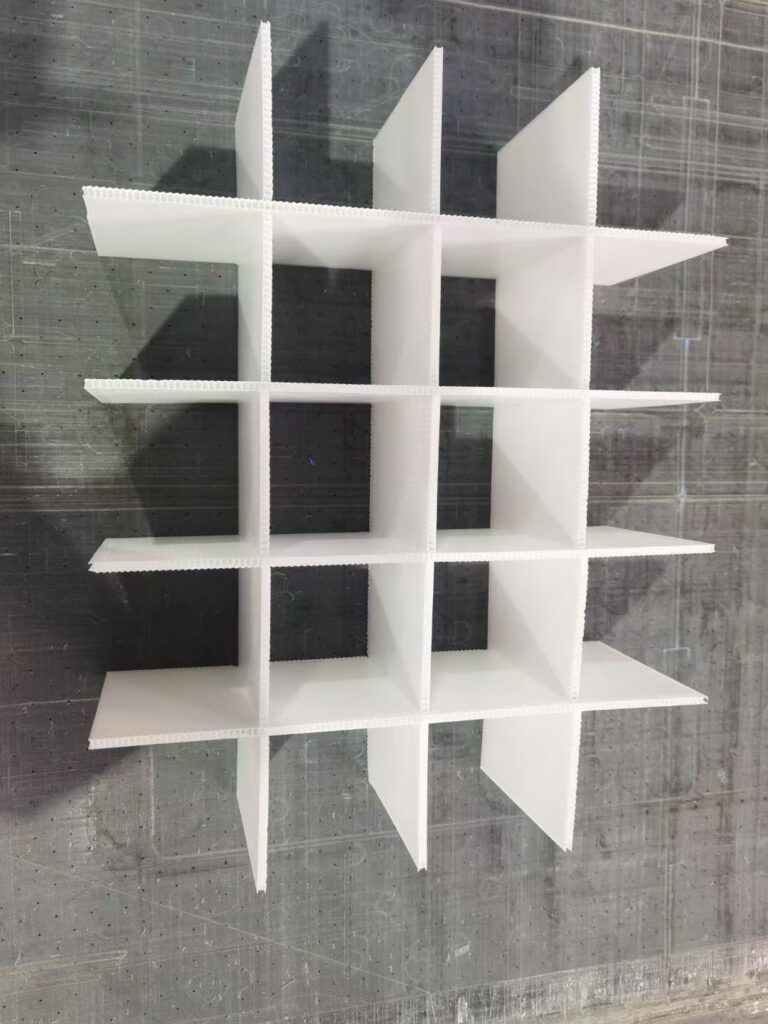
For a box with dividers or a reinforced rim, establish usable capacity before comparing costs. The internal versus external box size guide explains which dimensions need to be kept separate.
Calculate cost per loaded box trip
Set the program scope and evaluation period before entering costs:
Estimated cost per loaded box trip = (purchase and setup outlay + operating costs − estimated end-of-period recoverable value) ÷ completed loaded box trips.
For a forecast, use expected costs and loaded box trips for the same period. For an operating review, use recorded costs and trips, and list any remaining estimates separately. A result that includes estimated end-of-period recoverable value is still partly estimated. Date each version and state the period it covers.
| Worksheet line | What to include |
|---|---|
| Purchase and setup outlay | Initial boxes, dividers and fittings; replacement purchases; agreed tooling or setup costs allocated to this program |
| Operating costs | Return freight, collection, folding and assembly, sorting, inspection, cleaning, repair, storage and tracking attributable to the program; any packaging-related change in outbound freight or handling |
| Recoverable value at the end | A separately documented estimate of remaining usable value or disposal proceeds, net of related costs |
| Completed loaded box trips | Loaded movements within the defined route and period, counted consistently |
| Equivalent output | Product units delivered per trip, with the same acceptance requirements for each option |
List the included and excluded costs beside the worksheet. Include any packaging-related change in outbound freight or loading and unloading costs, and use the same allocation basis for both options. If unchanged transport costs are excluded, state that exclusion for both. Express costs in one currency, record the exchange rate and date for any conversion, and state the pricing period and whether taxes and duties are included.
Use this worksheet to compare packaging decisions; accounting depreciation requires a separate method. Show the upfront cash requirement separately too. Any remaining usable value is an estimate of future recovery. If that recovery is uncertain, calculate the result with zero recoverable value as well.
Check for double counting. Replacement purchases may already cover lost boxes, so adding a second purchase-cost allowance for those same boxes would overstate the cost. Check whether service charges include cleaning or return transport before adding either elsewhere. If you charge the full fleet purchase to a short evaluation period, account explicitly for any value assigned to the boxes left at the end.
Records to collect
Trace the empty boxes back from the receiving point. Record who collects them, where they wait, how they travel back and who releases them for reuse. Name the responsible party at each handover.
The Reusable Packaging Association includes return logistics, dwell time and the number of turns in its discussion of reusable-packaging economics. Mapping Reusables Into Your Supply Chain covers reusable systems generally. It provides no verified service life or savings figure for a particular PP box.
For your calculation, collect:
- A dated quotation showing the box configuration, included fittings, quantity, delivery basis and excluded charges.
- Return records showing collection frequency, empty-pack dimensions, boxes per return load and the actual freight allocation.
- Timings for assembly, inspection, cleaning and repair, with the applicable labor or service cost.
- Dispatch, receipt and ready-for-reuse dates, along with the number of boxes held at each location.
- Records of unreturned boxes and damaged boxes removed from service, including the reason for each removal.
Label unknown values as assumptions and decide how to check them during a trial. Sheet thickness, a product photograph or a “reusable” label cannot verify how many trips a box will complete.
Check what folding saves on the return route
Folding can reduce empty volume. Whether it saves money depends on the return load and the work needed to collapse and rebuild each box. Check the folded pack dimensions, how bundles are restrained, and how many empties fit in the return vehicle or allocated space.
Measure the added handling time too. A fixed box returning on an existing vehicle with spare capacity may leave little freight cost for folding to save. Where empty volume requires an extra collection, folding may have a larger effect. Base the estimate on the actual transport arrangement.
Define the loading and handling conditions before a trial using the returnable packaging handling requirements guide.
Compare scenarios before choosing a fleet
Hold the box design and output basis constant while changing one uncertain input at a time:
| Scenario | Question it should answer |
|---|---|
| Fewer completed trips | Does the decision still hold if reuse is below the initial forecast? |
| Slower return | How many more boxes and how much additional working cash would be needed? |
| Higher return or cleaning cost | Does the comparison depend on an unconfirmed service price? |
| More losses or early retirements | What replacement spending and availability problems follow? |
| No recoverable value | Does the result depend on a future resale or residual-value assumption? |
Compare cartons over the same route and delivered quantity, with the same product-protection requirements. Include their relevant purchase, preparation, handling and disposal costs. Calculate any change in product damage separately, using comparable records where available. Environmental benefits need their own assessment; the packaging-cost result alone does not establish them.
What to send for a PP box quotation
To discuss custom PP corrugated boxes, prepare the product dimensions, quantity per box, payload, stacking arrangement, estimated fleet quantity and return route. Include the destination country and delivery location so the quotation has a defined delivery basis. Identify the confirmed inputs and those still needing sample checks or operating validation.
The quote-without-a-drawing guide can help you prepare those details. Then request a quotation from Youqian Global using the known dimensions and quantity. The current inquiry form does not accept file uploads. Drawings or photos can be exchanged after the initial response.