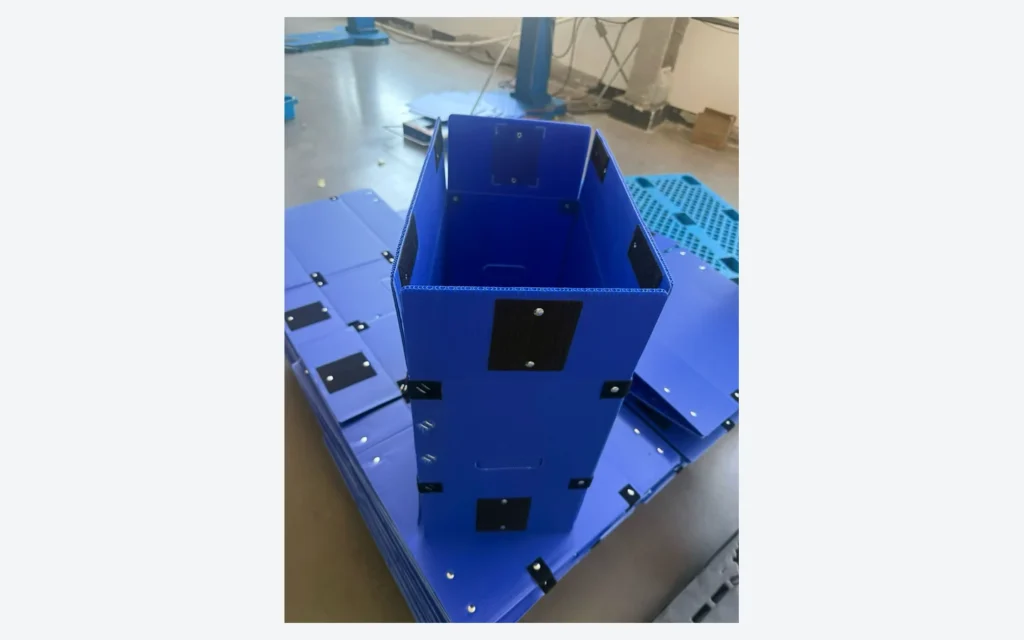
Foldable PP corrugated boxes can be supplied as flat, converted panels that are opened and secured for use. For a B2B packaging project, however, “foldable box” is only the starting point. The supplier still needs to understand what the box will carry, how it will be handled, whether it will be stacked and which details must be reinforced.
Quick answer: To request a useful quotation for foldable PP corrugated boxes, send the internal or external box size, product and loading weight, stacking requirement, folding and closure style, reinforcement needs, quantity and destination country. Add a drawing or sample photo when the box must fit an existing part or logistics loop.
What Is a Foldable PP Corrugated Box?
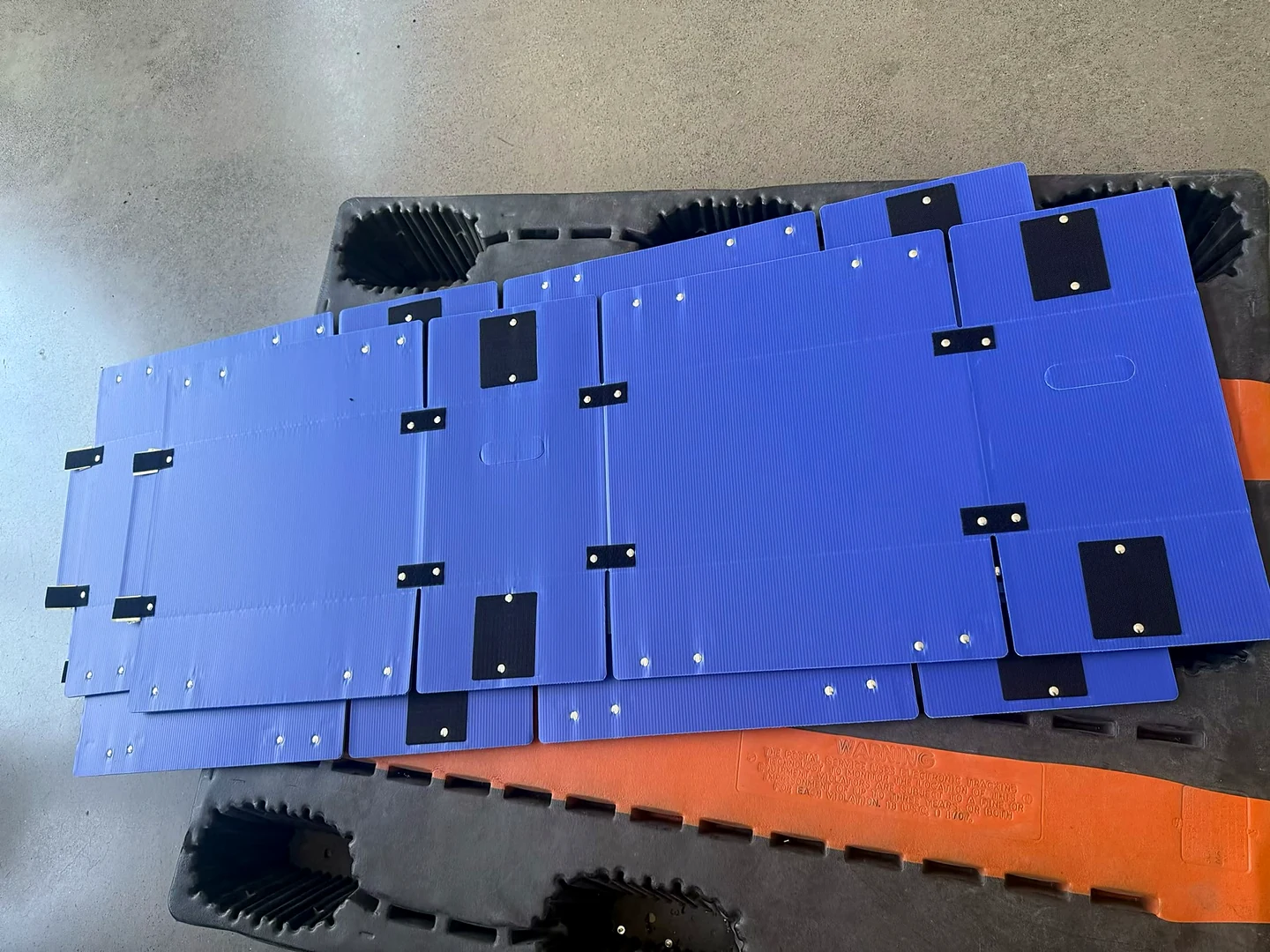
A foldable PP corrugated box is a converted packaging container made from twin-wall polypropylene sheet. Creases, slots, tabs, hook-and-loop closures, handles or other components can be added so the flat panel can be formed into a box.
The finished design may be used for parts handling, warehouse movement, line-side supply or other industrial packaging tasks. Whether it is suitable for a particular project depends on the complete box structure and use conditions—not on the sheet material alone.
This distinction matters when comparing suppliers. Two boxes with the same nominal dimensions may differ in panel construction, corner treatment, closure method, base structure and reinforcement.
Why Buyers Consider a Foldable Structure
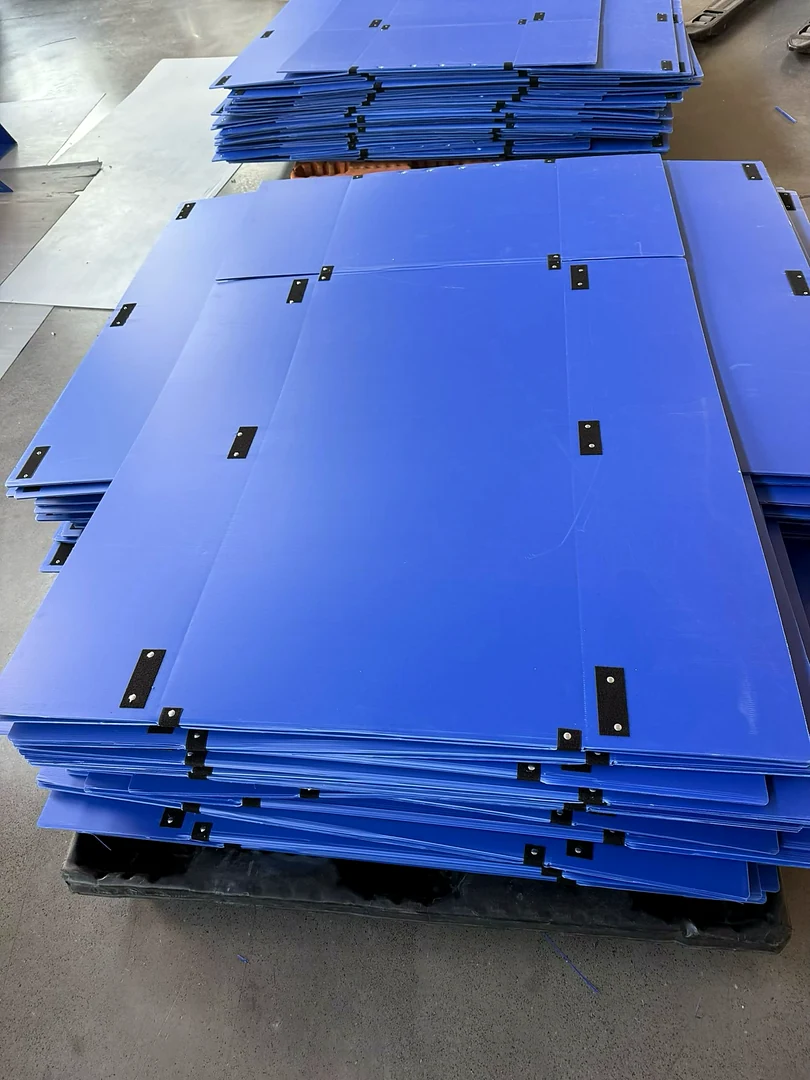
The visible benefit of a foldable design is the change between its in-use and flat states. When empty, converted boxes can be folded and bundled, as shown in the production photo above. This can make empty-box storage and handling easier to plan.
That does not mean every foldable style will suit every logistics process. Before choosing one, confirm:
- how frequently operators will open and close the box;
- whether the box travels empty after delivery;
- whether it will be stacked when full, empty or both;
- whether the contents create concentrated loads;
- whether a lid, divider or protective insert is required;
- whether the box must fit a pallet, rack, trolley or existing container.
These details allow the box geometry to be reviewed against the actual handling process.
The 7 Details to Include in a Foldable PP Box RFQ
1. Box size—and whether it is internal or external
Write dimensions in a fixed order, such as:
Length × Width × Height: 600 × 400 × 300 mm (internal)
Internal size is usually relevant when the box must fit a product, dunnage or divider set. External size matters when the box must fit a pallet position, rack or transport space. If both limits are critical, provide both.
Avoid sending three numbers without units or without identifying whether they are internal or external dimensions.
2. Product, loading weight and load distribution
State what the box will carry and the maximum planned loading weight per box. A supplier also needs to know whether the load is:
- distributed across the base;
- concentrated at several contact points;
- loose inside the box;
- held by dividers, foam or another insert.
This information is more useful than a general request for a “strong box.” If individual parts have sharp edges or unusual geometry, include a drawing or clear photo without confidential customer information.
3. Stacking and handling conditions
Explain whether filled boxes will be stacked and, if so, how many layers are planned. Also identify the handling method:
- manual carrying;
- trolley or conveyor movement;
- palletized handling;
- line-side storage;
- closed-loop or one-way shipment.
Stacking requirements influence the review of corners, edges, lid and reinforcement. Do not treat stacking strength as a material-only specification; the finished box structure and load pattern also matter.
4. Folding and closure style
Confirm how operators should assemble and close the box. Options may include tabs, hook-and-loop fasteners, lid flaps or a separate lid, depending on the project.
The best choice is operational: it should match how often the box is opened, whether tools are acceptable and whether all components must remain attached. A short assembly video or an existing sample can remove ambiguity.
5. Reinforcement, handles and inserts
List any features the quotation must include instead of assuming they are standard:
- edge or corner reinforcement;
- reinforced base;
- hand holes or fitted handles;
- label holder;
- printing or identification;
- lid;
- PP divider set or cell partition;
- other protective insert.
For a divider, provide the part size, desired cell layout, divider height and loading orientation. A box and its internal dunnage should be reviewed as one packaging system when they must work together.
6. Quantity and project stage
Give the estimated order quantity for each size or design. If the project begins with a sample or pilot quantity and may later move to a production order, state both separately.
Quantity affects tooling, conversion planning, packing and export arrangements. Avoid combining several variants into a single total; list the quantity for each box size, color or printed version.
7. Destination and export packing
Include the destination country and, when known, the delivery port or city. Tell the supplier if there are pallet size, bundle height, labeling or receiving constraints.
For a foldable design, export packing should be discussed together with the box structure. The flat-packed panel dimensions, bundle method and accessories all affect the final packing plan.
Foldable, Fixed-Form or Divider-Fitted: Which Brief Do You Need?
| Project need | Details to emphasize in the RFQ |
|---|---|
| Foldable box | Flat and assembled dimensions, assembly method, closure, folding frequency |
| Fixed-form box | Finished dimensions, corner/base construction, stacking and handling |
| Box with dividers | Box size plus part size, cell count/layout, divider height and orientation |
| Palletized packaging | External footprint, boxes per layer, planned stack layers and pallet constraints |
This table is a briefing guide, not a performance rating. The final construction should be reviewed against the product, load and logistics process.
Copy-and-Send RFQ Template
Use this template when contacting a PP corrugated box supplier:
Product to be packed:
Box size: ___ × ___ × ___ mm (internal / external)
Maximum loading weight per box: ___ kg
Load distribution or part drawing: ___
Stack requirement: ___ layers when filled / empty
Handling process: manual / trolley / conveyor / pallet / other
Fold and closure style: ___
Reinforcement, handles, lid or dividers: ___
Color and printing: ___
Quantity by design: ___
Destination country and port/city: ___
Sample or target delivery requirement: ___
If some details are not decided, describe the handling problem and mark the unknown fields. This gives the supplier a practical basis for asking the right follow-up questions.
Common RFQ Mistakes That Slow a Box Review
Sending only a finished box photo
A photo can show the concept but rarely confirms internal size, load, stacking or materials. Add dimensions and operating requirements.
Asking for a “standard strong box”
Strength is not one universal grade. Define the load, distribution, handling and stack instead.
Omitting the empty-return process
If empty boxes will be folded, returned or stored, explain the expected process. It may affect the closure and attached components.
Treating the divider as a separate afterthought
If cells or partitions locate the product, include them in the first brief so the internal fit can be reviewed with the box.
Leaving out the destination
The destination and packing constraints are necessary for export planning and for a more relevant quotation.
Frequently Asked Questions
What information is needed for a foldable PP corrugated box quote?
Send the box size, product and maximum load, stacking requirement, closure style, reinforcement or insert needs, quantity and destination. A drawing is useful when the box must fit a specific product or logistics system.
Should I provide internal or external box dimensions?
Identify which dimension you provide. Internal dimensions help check product fit; external dimensions help check pallets, racks and transport spaces. Provide both if both are controlled.
Can a PP corrugated box include dividers?
Divider sets can be reviewed as part of a custom box project. Provide the part dimensions, cell arrangement, divider height and loading orientation.
Does a foldable box always reduce shipping cost?
Do not assume a guaranteed saving. Flat packing changes the empty-box packing configuration, but the commercial result depends on panel size, bundle method, accessories, shipment quantity and route.
How should stacking requirements be described?
State the load per box, how the load is distributed, the planned number of stack layers and whether stacking occurs during storage, transport or both.
Can I request a sample before a production order?
Describe the sample requirement and the estimated later order quantity separately. The supplier can then review the sampling and production stages against the design.
Check the Sample Against the Handling Brief
Check the sample with the actual packed item, any divider or cushioning, and the planned pallet support. Confirm usable internal dimensions, loading and unloading access, closure fit and the agreed folded dimensions. Check handle and joint details under the intended handling conditions. Record any fit or handling issues before confirming the production specification.
Agree on stacking and reuse checks for the complete packed assembly under the intended support, storage and transport conditions. Sheet thickness alone does not establish a safe load or service life.
For related product information, see PP corrugated boxes and packaging solutions.